China''s Rise in Advanced Industries: Catching Up or Pulling Ahead? A Deep

China has not yet taken an overall lead in advanced industries, but it is
China’s Rise in Advanced Industries: Catching Up or Pulling Ahead? A Deep Dive into Sectoral Shifts and Policy Implications
Introduction: The Real State of Play in Advanced Industries
Over the past 25 years, China’s share of global advanced-industry output has surged from roughly 6% to over 20%—a meteoric rise that has reshaped manufacturing supply chains and sparked intense debate in Washington, Brussels, and Tokyo. Yet the 2024 report from the Information Technology and Innovation Foundation (ITIF), a leading think tank on innovation policy, delivers a nuanced verdict: China has not achieved overall leadership in advanced industries, but it is closing the gap at a pace that demands strategic attention.
[IMAGE: Infographic showing a timeline of China’s share in advanced industries (Hamilton Index) from 2000 to 2024, with key sector callouts.]
The ITIF report, titled “How China Catches Up in Advanced Industries,” tracks 10 critical sectors using the Hamilton Index—a composite measure of output, trade, and innovation. The findings challenge two simplistic narratives: the alarmist view that China already dominates everything, and the complacent view that Western superiority remains intact. Instead, the data reveals a dual-track pattern: China has leapfrogged in a handful of priority sectors through massive state-backed investment, while in others—particularly those rooted in fundamental science and complex systems integration—it still trails the West, though often by a narrowing margin. This article unpacks the sectoral specifics, the hidden logic behind China’s industrial strategy, and what it means for global competition, supply chains, and the next decade of innovation.
Where China Leads: Electric Vehicles, Batteries, and Nuclear Power
The ITIF report identifies three sectors where China is either on par with or pulling ahead of leading Western economies: electric vehicles (EVs) and batteries, commercial nuclear power, and certain segments of clean energy equipment.
Electric Vehicles and Batteries: The Uncontested Supply Chain King
China’s dominance in this sector is the most visible and consequential. In 2023, Chinese automakers sold roughly 60% of all EVs globally, and China accounted for more than 70% of global battery cell production capacity. The lead extends beyond assembly: China controls the entire battery supply chain—from lithium refining (over 60% of the world’s capacity) to cathode and anode production, to the final pack integration. Companies like CATL and BYD have achieved cost advantages that foreign rivals cannot match, largely because of scale and a decade of government subsidies, tax breaks, and local-content requirements.
Critically, this is not just a manufacturing story. China’s EV ecosystem benefits from a state-directed industrial policy that coordinates battery research, charging infrastructure, and low-cost financing. The ITIF report notes that the U.S. and Europe have begun to counter with their own subsidies (e.g., the Inflation Reduction Act), but they remain years behind in cost and supply chain depth.
[IMAGE: Photo of a Chinese EV assembly line (BYD or NIO plant) with battery modules, plus a chart comparing global EV market share by country.]
Commercial Nuclear Power: Building Faster, Building Cheaper
China’s nuclear power program is less talked about but equally telling. The country currently has 55 operational reactors and 23 under construction, more than any other nation. Its homegrown Hualong One reactor—a Generation III pressurized water reactor—is now being exported to Pakistan, Argentina, and possibly Saudi Arabia. Crucially, China’s reactor construction timelines (around 7–8 years) are roughly half of those in the U.S. or France, driven by standardized design, centralized decision-making, and fewer regulatory hurdles.
The ITIF assessment places China “on par or ahead” in commercial nuclear energy, particularly in deploying next-generation technologies like small modular reactors (SMRs) and high-temperature gas-cooled reactors. For a world committed to decarbonization, this gives Beijing significant pricing power and technology standard-setting leverage—especially if Western nations fail to streamline their own regulatory and construction processes.
The Lagging Sectors: Robotics, Biopharma, Chemicals, and AI – Progress but Not Parity
Yet for all its rapid gains, China still lags in several advanced industries where the U.S. and its allies retain clear leads. The ITIF report ranks China below the U.S., Germany, or Japan in industrial robotics, biopharmaceuticals, specialty chemicals, and fundamental AI research, though the gap is narrowing fastest in areas where China can leverage huge domestic data sets and manufacturing scale.
Robotics: Density Rising, Core Components Still Weak
China is now the world’s largest market for industrial robots, installing 50% more units than the U.S. in 2022. Its robot density (robots per 10,000 manufacturing workers) has grown faster than any other country, surpassing Germany by some measures. However, the ITIF report points out that China remains heavily dependent on imported precision gearboxes, servo motors, and controllers—core components produced by Japan’s Fanuc, Germany’s Kuka, and Austria’s ABB. Domestic robot makers like Siasun and Estun have made progress, but they still rely on foreign technology for high-end applications.
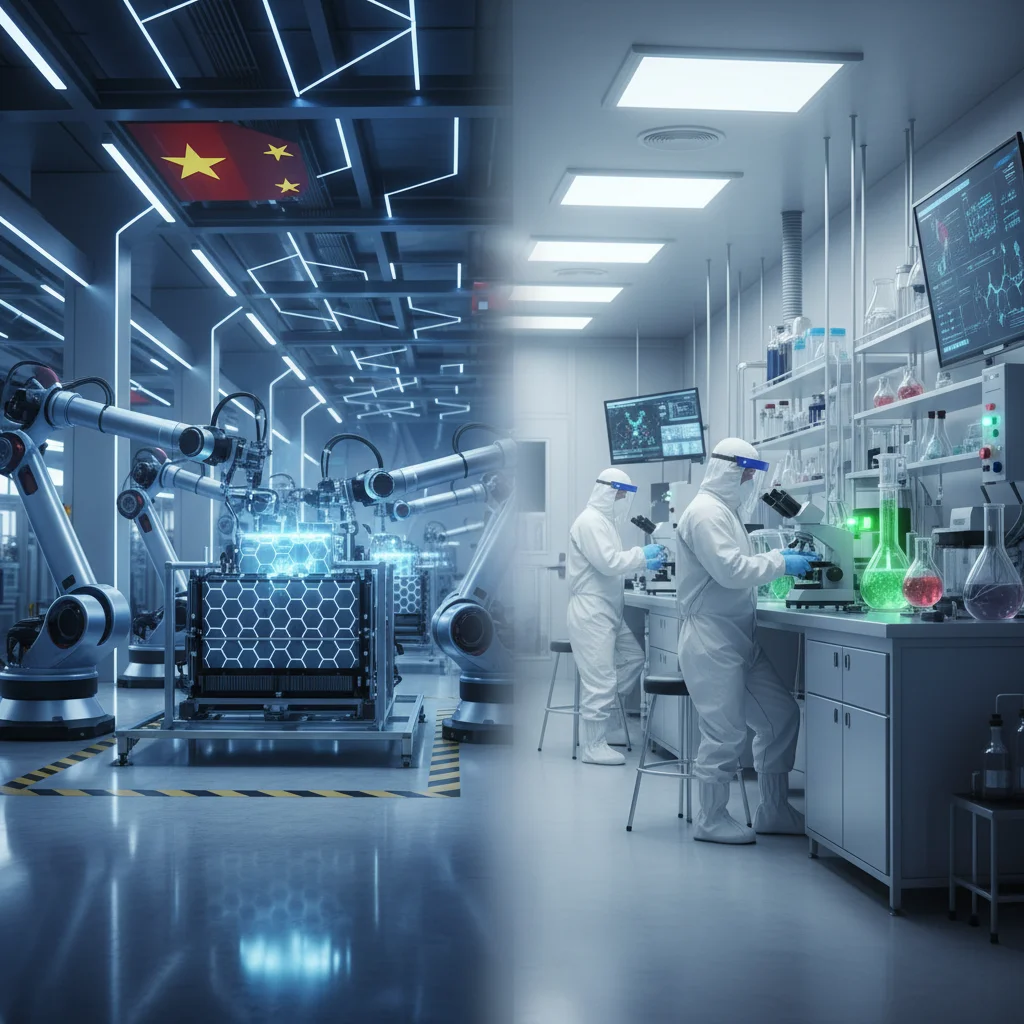
[IMAGE: Split visual: left side shows Japanese/German robotics lab, right side shows a Chinese factory with newer collaborative robots; overlaid with a bar chart of R&D spending in AI per sector.]
Biopharmaceuticals: Biosimilars Boom, Novel Drugs Still Scarce
China’s biopharma sector has expanded explosively, driven by a surge in contract research organizations (CROs) like WuXi AppTec and a pipeline of biosimilars and generic drugs. Patent filings in biology and chemistry have skyrocketed. Yet the gap in original drug discovery and novel therapeutics remains significant. As of 2024, only a handful of Chinese-origin drugs have received FDA approval, while U.S. and European companies still dominate first-in-class molecules. Regulators in China have streamlined clinical trial approvals, but the underlying science ecosystem—particularly early-stage academic research and venture capital for high-risk drug development—is still maturing.
According to analysts at the China Institutes of Contemporary International Relations, “the gap is not insignificant, but the growth rate is rapid.” This observation holds equally for AI.
Artificial Intelligence: Applications Flourish, Foundations Lag
China has emerged as a leader in applied AI, especially in computer vision, natural language processing for Chinese, and industrial automation. The number of AI research papers and patents from Chinese institutions has soared, and companies like SenseTime and Baidu have developed competitive large language models. However, the West—particularly the U.S.—still leads in foundational AI research, including breakthrough architectures like transformers, multimodal models, and frontier reinforcement learning. The ITIF report notes that China’s AI ecosystem relies heavily on open-source frameworks from the U.S. (e.g., PyTorch, TensorFlow) and faces increasing restrictions on high-end semiconductor imports, which could slow future advancements.
The Hidden Logic: State-Led vs. Market-Led Innovation Models
What explains this uneven pattern of catching up? The ITIF report suggests a structural difference in innovation models. China pursues state-led targeted leapfrogging: clear national priorities (EVs, nuclear, 5G/6G) receive massive, coordinated funding, preferential procurement, and regulatory fast-tracking. This approach has proven highly effective for sectors with large capital requirements and a clear technological trajectory—exactly where China leads today.
In contrast, Western innovation—especially in the U.S.—relies more on market-driven, decentralized discovery, where venture capital, university research, and competitive markets push new ideas to commercialization. This model excels in areas requiring deep scientific breakthroughs (e.g., novel drug mechanisms, foundational AI algorithms, advanced robotics control systems) but can be slower and more fragmented in capital-intensive scaling.
[IMAGE: Diagram comparing state-led vs. market-led innovation cycles, with arrows showing feedback loops and bottlenecks.]
The ITIF report’s policy recommendations for the U.S. explicitly aim to blend the strengths of both models. Key proposals include:
- Creating new sector-specific research institutes modeled on the Defense Advanced Research Projects Agency (DARPA) but focused on commercial advanced industries like biomanufacturing and robotics.
- Expanding tax credits for domestic production of critical components (batteries, semiconductors, rare earth processing) to match China’s subsidy depth.
- Strengthening the U.S. export control regime while simultaneously investing in domestic alternative supply chains—a dual strategy of “decoupling and rebuilding.”
Thus, the core debate is not whether China will overtake the U.S. in all advanced industries—it likely won’t—but whether the Western market-led system can adapt quickly enough to maintain leadership in the sectors that matter most for national security and long-term economic resilience.
Long-Term Implications: Supply Chains, Ecosystems, and Business Competition
The sector-level analysis from the ITIF report carries profound implications for global supply chains and innovation ecosystems.
First, China’s lead in EVs and batteries is unlikely to erode soon. The incumbent advantages in lithium processing, battery chemistry, and manufacturing scale are self-reinforcing. Western automakers will continue to face a cost disadvantage unless they forge deep joint ventures or localize supply chains—both time-consuming and expensive. The resulting pricing power could affect everything from transport decarbonization timelines to the balance of trade.
Second, specialty chemicals and advanced materials present a hidden vulnerability for the West. China already dominates the production of many specialty chemicals used in pharmaceuticals, electronics, and defense. The ITIF report warns that China is now investing in high-end varieties, aiming to replicate the strategy that gave it control over rare earths and lithium-ion battery materials. Companies and governments should monitor these moves closely.
Third, the AI and biopharma gaps highlight where the West can still maintain advantages—but only with sustained public investment. AI foundational research remains a U.S. strength, but the growing restrictions on semiconductor exports could create a bifurcated global AI ecosystem, with China developing its own hardware-software stack (e.g., Huawei’s Ascend chips and Pangu models). In biopharma, the rapid rise of Chinese CROs means Western pharma firms increasingly rely on Chinese partners for preclinical and clinical services—a dependence that carries risks for intellectual property and supply continuity.
[IMAGE: Map of global supply chain flows for EV batteries, with China at the center and arrows showing lithium, cobalt, and nickel sources plus battery export destinations.]
Finally, the ITIF report underscores that business competition will become more political. As China continues to close gaps, Western governments will face pressure to deploy industrial policies that were once taboo—direct subsidies, local content rules, and research coordination. This does not mean a return to 1970s-style protectionism, but rather a new era of managed competition in which market forces coexist with strategic state interventions.
Conclusion: A Nuanced View Beyond Simple Narratives
The story of China’s rise in advanced industries is not one of unstoppable takeover or Western complacency. It is a story of strategic concentration, uneven progress, and deliberate policy choices. China has pulled ahead in sectors where massive scale and government coordination provide clear advantages—EVs, batteries, nuclear power. It still lags in robotics, biopharma, and AI foundations, but the gap is closing at a pace that demands proactive responses.
For policymakers in the U.S. and Europe, the ITIF recommendations offer a roadmap: invest in R&D, restructure supply chains, and compete on speed of execution. For businesses, the lesson is that global supply chains are entering an era of fragmentation and duplication—requiring parallel sourcing, technology licensing, and scenario planning.
Above all, the data cautions against binary thinking. China is not “catching up” across the board; it is selectively leapfrogging where it has placed strategic bets. The West still leads in areas of deep science and complex ecosystem integration—but only if it can mobilize the same level of sustained, coordinated effort that Beijing has mastered. The next decade will test whether the liberal market model can evolve fast enough to stay ahead—or whether the world is witnessing the beginning of a more fundamental shift in the geography of industrial power.
Forward-Looking Content Notice
Coverage of emerging technology, business evolution and future society may include forward-looking scenarios. Technologies, claims and forecasts can change quickly, and the material is not investment or professional advice.